Wednesday, February 2, 2011

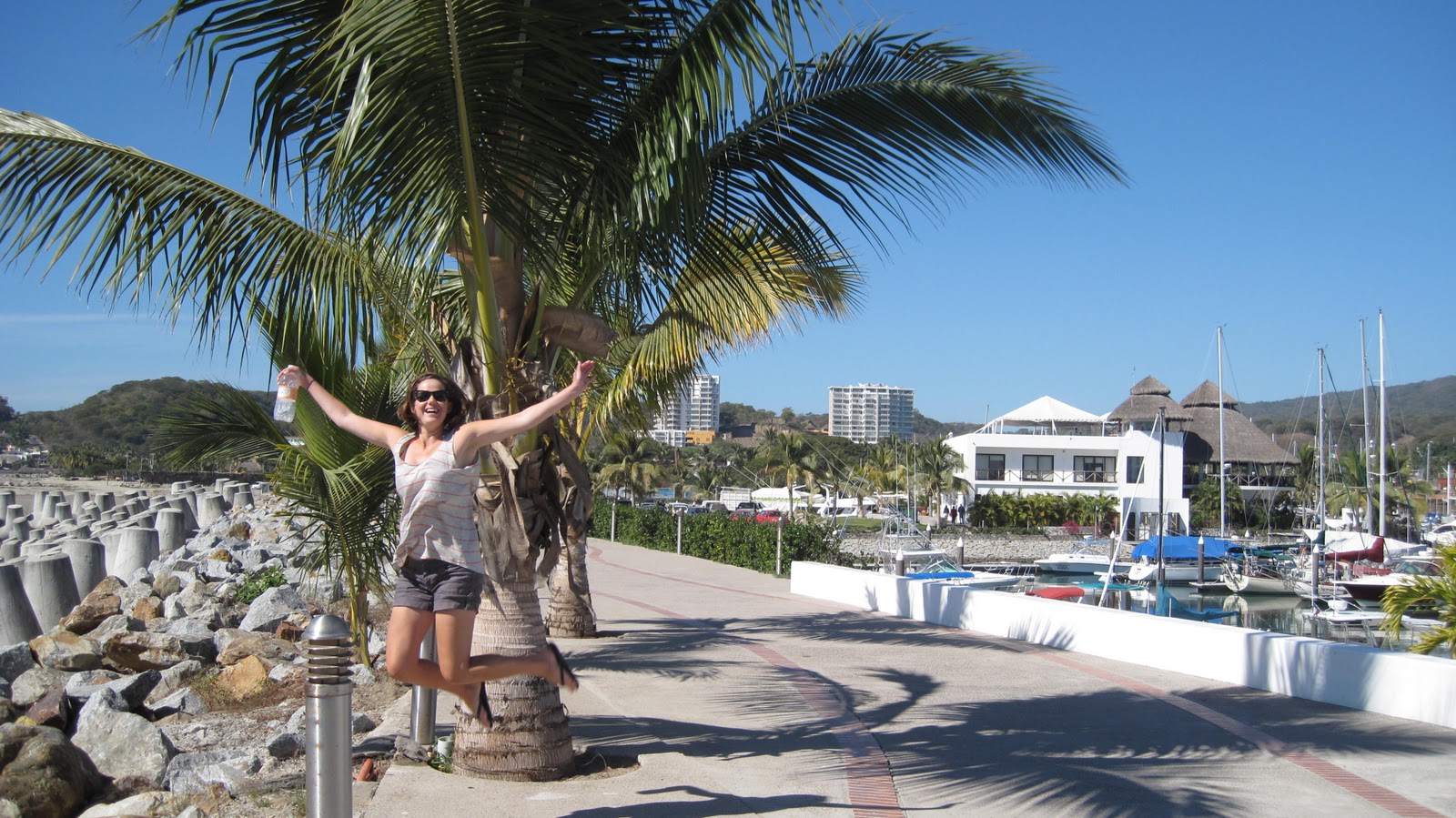
Puerto de la Navidad and the Grand Bay Hotel

Norwegian Steam Moored by the Grand Bay Hotel
One of the Beautiful Pools at the Grand Bay
We arrived yesterday at Barra de Navidad, after a four hour trip from Tenacatita.  Barra has been a goal for me ever since we visited the town by automobile when we were vacationing with our friends Marcia and Brooks in Manzanillo five years ago.  Barra is really cool.  Part beach town, part Mexican village.  Next to the town is a lagoon, and the barra referenced in its name is the bar that must be crossed when passing from the ocean to the lagoon.  I have heard that it is possible for this to be a bit dicey if the ocean swell is running high, but when we entered it was a piece of cake.  It's just a bit hard finding the entrance which is not even shown on the expensive California/Mexico chart package I have running on our Garmin 4212 chart plotter.  Thankfully, cruisers who have successfully passed this way before have published GPS waypoints.  I used those from Pacific Mexico, by Breeding and Bansmer. 

Brooks, Marcia, Sally and Alan at the Grand Bay
Many cruising sailboats simply anchor in the lagoon.  We are in the Puerto de la Navidad Marina, however, which is located just beyond the aforementioned entrance, on the side opposite the town of Barra.  The marina is associated with the Grand Bay Hotel.  Our visit is going to be a reunion inspired by our first trip here because Marcia and Brooks will be staying at the Grand Bay, a place they have stayed before and like quite a lot.

View from a Beach Restaurant in Barra de Navidad
The Grand Bay Hotel is very much a Disney Land for the middle aged and elderly.  Impressive fantasy architecture.  Very clean with good service.  There are a lot of swimming pools, tennis courts, a spa, a gym, etc.  As marina guests, we have the use of many of these facilities.  This is without a doubt the most expensive marina that we have stayed in.  We may be here a month in all, because it turns out that staying 10 days is just as expensive as a month.  Even the Internet service is very pricey, but at least it works well.

The Fantasy Architecture of the Grand Bay with Barra Beyond
Barra is in the Mexican state of Jalisco, the same state as Puerto Vallarta.  The marina and the hotel are in Colima, however, because the boundary between the two states runs right down the middle of the entrance to the lagoon.  Red buoy in Colima, green buoy in Jalisco.  There is also a small town on the lagoon, but not the ocean, called Colimilla, on the Colima side, with restaurants and some other facilities.  But the real action is in Barra, and one of the great things about this place is the excellent panga taxi service.  You can go from the hotel or marina to Barra for 20 pesos (about a buck fifty) per person round trip and you can return from Barra at any time of the day or night.  It costs only 25 pesos for people on boats anchored in the lagoon which is actually at least twice as far.

Our current Google Earth compatible location: 19 11.735'N,104 40.981'W

Sunday, January 30, 2011

Tenacatita

After two nights in Chamela, we motor sailed the 30 nautical miles to Bahia Tenacatita (19 degrees 17.994 minutes north, 104 degrees 50.150 west). This is a large and beautiful bay with several anchorages. We are in the one which provides the best protection from northwesterly swells.

Today we saw two humpback whales within a hundred feet of the boat, a sea turtle at about the same distance, and we were escorted into Tenacatita by dolphins up close and friendly. We have seen many jumping sting rays, but today one jumped so close to Norwegian Steam we feared it might leap aboard. The wildlife viewing gets better and better.

As soon as we anchored, Sally and Amy donned swim suits, leaped off the boat, and swam the third of a mile to the beach. I was left behind to pump up the dinghy and then to row ashore to fetch them and row them back to the boat. We all get our exercise, one way or another.

Tonight Sally is preparing Linguine Primavera.
----------
radio email processed by SailMail
for information see: http://www.sailmail.com

Saturday, January 29, 2011

Whales and Sea Turtles

Yelapa is a Hill Town
Tonight (January 28, 2011), Norwegian Steam is anchored very peacefully in Bahia Chamela (19 degrees 35.09 minutes north, 105 degrees 7.892 minutes west), after an overnight voyage from Banderas Bay.  Last night we anchored in Yelapa, a small indentation in the south side of Banderas,  but found the four foot high swells anything but peaceful and decided to start the 89 nautical mile journey to Chamela immediately.  Yelapa is a fascinating place, and we had intended to stay longer.  According to the excellent Pacific Mexico, A Cruiser's Guidebook, by Breeding and Bansmer, all land is owned collectively in Yelapa based on a grant to a group of indigenous people in the year 1581 by King Phillip II of Spain.  Yelapa has a small beach, with the usual collection pangas (large, high-powered, all-purpose skiffs) and palapa (thatch roofed) restaurants.  What really makes it special, however, is that it is a hill town, with tiny winding streets, mostly too narrow for automobiles, which require goods to be carried by horse and mule.  A creek runs down through the village, and higher up there are two waterfalls.  We viewed one of these on the same day that Sally finally saw a whale.

Whale sightings have now become common-place.  We have seen two distinct species and possibly more.  One type is very long and we think could be fin whales, although a number of other whales have a somewhat similar appearance, including the blue whale.  The other is definitely the humpback.  Today we were very close to a pod of them as they blew and breached.  Later we saw some more of them continually pounding the water with their tails for several minutes.

We have also solved a little mystery involving what seemed to be either the remains of dead seals or some kind of large net float.  Today we saw several up close, and they are neither dead nor inanimate.  They are sea turtles.

We arrived in Chamela about three in the afternoon, and after anchoring, we inflated the dinghy and headed for shore.  Sally and Amy wore bathing suits under their clothing.  I had no intention of swimming but, knowing a dunking was very possible, I had donned shorts.  We placed cameras, money and clothing in a dry bag.  Nearly to the beach, we were upset and needed to jump into the water and drag the dinghy up the beach.  Fortunately, we had left the outboard back at the mother ship.  Since they were already wet, Sally and Amy decided to go swimming right then and there, while I strolled down the beach to select a palapa restaurant.  I chose the third one because there were two young gringo guys sitting there and I thought I might get some information about the wonders of Chamela from them.  After ordering a beer, fish tacos and guacamole, I started a conversation.  They told me they lived on the other side of the bay and that they were doing marine research.  They noted that they were actually being paid to live in such a warm and beautiful place.  Sensing a slight imperfection of accent in their otherwise perfect American, I asked where they were from.  Norway, it turns out, and there are fifty Norwegians in all living in the bay and working on the research project.  I then asked them the question that I now ask all young Norwegians that I meet: "Do you like pickled herring?"

A bit of background.  As far as I know, all Scandinavian Americans love pickled herring, and until 20 years ago, I had assumed that their love for this delicacy was genetic.  In 1991, we spent a week at Disney World, in Florida, including a day at the Epcot Center, which includes a number of internationally themed restaurants surrounding a lagoon.  One of these is a Norwegian restaurant, where I had dined on two previous occasions.  The waiters and waitresses in this restaurant are young Norwegians, boys and girls who have been awarded the privilege of a year in Florida.  There must have been two dozen varieties of pickled herring.  Those with simple wine, vinegar, onion and juniper berries, those with cream sauce, mustard sauce and so on.  I asked the blond and bronzed surfer who was our waiter which of the pickled herrings he would recommend.  The answer was a shock.  "If I were to eat pickled herring, I would choose that one.  But I do not eat pickled herring."  Two years ago a family of relatives from Norway visited us in Seattle.  I asked the same question.  Not only did they not eat pickled herring, they did not like seafood.

So the answer to the question posed to two young Norwegians on the beach at Bahia de Chamela was not a complete surprise.  Only a reinforcement of my growing recognition that Norway is no longer what it once was.  One of the two, he who is blond and bronzed, had already mentioned that he had lived a year in Florida.  As I related the Epcot Center saga, he got a strange look on his face, and said he had worked a year in that same restaurant.  No, not the same guy.  This fellow would be too young.  Just the same race.  What a pity.  Pickled Herring is almost as good as fresh yellow tail with mustard sauce and it keeps a good deal longer.

On our way back out to the boat, we found it completely impossible to get through the surf with oars and three people in the dinghy.  Three times, we would almost clear a breaking swell, get turned around, and surf back towards the beach, finally being overturned.   In fact, a lot of fun!   Finally, Sally and Amy got back into the water, pushed the dinghy through the surf break and swam back to the boat, while I rowed her back.

Tonight Sally is preparing the pasta she had planned to serve in Yelapa, but could not because of the erratic rolling at anchor in ocean swells.

Finally a taste of the irony of the modern wired world.  During the ten days we spent in the modern marina at La Cruz on Banderas Bay the WIFI was pathetic.  So bad, that one of my posts to this blog had to be made via marine single side-band radio.  In this remote bay, we are enjoying an open WIFI access point with much better response and through-put than the marina was able to provide.

Wednesday, January 26, 2011

Seafood Lovers Paradise

Loren, Sally, Alan and Amy
Pacific Mexico is not just sailing and sun bathing.  These pleasures are equaled or even eclipsed by the enjoyment of seafood.  Great mariscos everywhere.  I have been feasting on camarones (shrimp), atun (tuna), dorado (mahi-mahi) and marlyn (marlin).  Amy's uncle Loren, who was here for nearly a week, ate camarones at every meal.

Moon Over La Cruz
Between Meals, Alan and Loren Check Out the Music Scene
At Frascati's, an Italian-Mexican restaurant in La Cruz, I had the best tuna that I have ever eaten.  They serve it seared or pink.  In Seattle, if you order your tuna any way other than seared the waiter will instantly relegate you to the ranks of the hopelessly uncool.  Of course, preparing seared tuna is easy and safe.  You hardly cook it at all and thus avoid the risk of overcooking, which turns the best ahi instantly into something that could have come from a can.  You avoid embarrassment by intimidating the customer into eating the fish raw.  Frascati's chef is a real man (or woman, haven't actually met the individual) -- a risk taker par excellence.  He (she) cooks the fish just the right amount.  Perfection!

Also at Frascati's I had a great pizza fruti di mare.  It was ten times better than the same dish at La Fontanelle on the banks of Lac de Genval near Brussels, which I ordered many times when we lived there and which had previously been the yardstick by which I measured seafood pizzas.

But you don't have to go Italian to get great seafood meals.  It seems that all of the traditional Mexican presentations such as burritos, quesadillas, tacos, as well as regional specialties such as papas (baked potato) in La Paz, can be the basis of a meal of seafood.  The mariscos are invariably fresh and delicious. 

In Search of Seafood
Of course, you can also buy seafood at the market and cook it the way you like it.  The prices here are outstanding.  Freshly caught tuna goes for 110 pesos (less than ten dollars) per kilogram (2.2 pounds).  Mahi-mahi goes for 90 pesos per kilo.  Yes, this is a seafood lover's paradise.

Tuesday, January 18, 2011

Puerto Vallarta

Amy is Thrilled to be in La Cruz at Last
We finally made it to Puerto Vallarta, or almost, since we are not in PV proper, but at La Cruz, which is just a bit to the north. We arrived just after sunup, after a crossing from Bahia los Frailes which took three nights and nearly three days. The first day and night were very rough, but things got better after that. After the winds got back to normal and the seas moderated, there were many hours of beautiful sailing. We made it in time to get Andy Morse onto his scheduled flight to Hawaii. Our daughter Amy will be with us for a few more days. Thanks to both for their company and help.

We are moored in the pretentiously named Marina Riviera Nayarit de La Cruz de Huanacaxtle, an impressive new marina with lots of nice facilities and services. Unfortunately, reliable Internet wireless service is not one of them. In my experience, most web sites for marinas in Mexico are absolutely pathetic. They typically attempt to integrate fancy audio and video, but end up with something that does not work and is just annoying. The Marina Riviera (etc.) site is an exception and therefore I thought they might be able to provide usable WIFI.
Wishful thinking. This blog entry will have to be posted via HF radio and Sailmail.
We intend to be here at least a week, to rest and to make a few repairs and improvements before heading south to Barra de Navidad.
----------
radio email processed by SailMail
for information see: http://www.sailmail.com

Saturday, January 15, 2011

Rangval Redux

Andy on Watch
Amy on Watch
I write this from Norwegian Steam as she approaches the midpoint of our 282 nautical mile voyage from Los Frailes to Puerto Vallarta. We started yesterday morning after having spent three nights anchored in Frailes, hoping to wait out a strong norther, not daring even to go ashore for fear that the 2 hp. engine on our dinghy might not be powerful enough. As we started out, Sally was at the helm, sailing at two to three knots without any sails up. I hooked our Monitor wind vane self steering to the tiller. It is customary to personify a self-steering gear, as if it were a human helmsman. I chose to call ours Rangval, to honor my paternal grandfather, who was big, strong, helpful and reliable, all traits of a good helmsman. After fifteen minutes we hoisted our new storm jib, the smallest headsail on the boat, which is of very heavy traditional constuction, sewn by Schattauer Sails. Out speed jumped to five and half knots. It was clear the norther was not over. After another eight hours we hoisted the staysail alone on the headstay. Still no mainsail. The wind was coming over the port quarter and that was also the dominant direction of the seas. We spent a very uncomfortable day and night, rolling and yawing, sometimes violently, in the quartering seas.
Today both wind and waves have diminished. Four foot waves have replaced eight footers. Now we are running wing-on-wing at six knots, with full main and the yankee poled out to windward. The motion is much more comfortable. Finally Amy may be able to get some sleep. Rangval is steering masterfully.
Our current position is 21 degrees 55.4 minutes north, 107 degrees 43.4 minutes west.
Sunrise on the Ocean
----------
radio email processed by SailMail
for information see: http://www.sailmail.com

Tuesday, January 11, 2011

Beach Club at the Bay of Dreams

Since we left La Paz to sail to Puerto Vallarta, NS has been crewed by Sally, Alan, Amy and Andy Morse (a friend of Jennifer and Andrew). Last night we all dined at the 1535 Restaurant, located in the Beach Club at the Bay of Dreams. Quite a good restaurant and not expensive.

Los Muertos or The Bay of Dreams
The Beach Club is at the east end of a long sand beach in Ensenada de los Muertos (23 degrees 59.2 minutes north, 109 degrees 49.6 minutes west). At the other end of the beach is a real estate development. A name that translates to "Cove of the Dead" was not was deemed satisfactory for the location of a sparkling new gringo retirement community and golf course, and thus was born the "Bay of Dreams." I have read, by the way, that in this case "muertos" does not refer to dead people, but instead to large abandoned anchors from a time when the bay was a cargo port. Years ago, dead anchors and chains were probably a hazard to small craft anchoring in the cove, but they have long since silted over and Muertos is a favorite stop for yachts traveling this stretch of coast.
Los Muertos or The Bay of Dreams

Tonight we are anchored in Bahia Los Frailes (23 degrees 22.9 minutes north, 109 degrees 25.2 minutes west), a favorite anchorage for yachts awaiting favorable weather for either a passage across to the Sea of Cortez to mainland Mexico or for a trip north against the prevailing winds. It was a fast run down from Los Muertos with 25 knot winds and six to eight foot seas. Amy and Andy proved the value of young reflexes for steering a boat in these conditions. When we made the final turn into the bay, what had been a following wind was suddenly on the beam and we were a bit over-powered, but it was only a quarter of a mile from there into the bay which provides protection from the waves if not from the wind. We are now well anchored.
----------
radio email processed by SailMail
for information see: http://www.sailmail.com